About
Creator is an AI-powered influencer-marketing platform that connects and empowers brands and creators.

Overview
How it started
As the sole & lead designer, I led a full redesign to rebuild the product’s foundation: connecting product strategy, user experience, and brand identity into one scalable system.
Over 18 months, collaborating closely with marketing, client service, engineering, product leadership, and the CEO, I rebuilt the company’s brand, product, and design systems from the ground up - improving usability, introducing AI-powered workflows, and helping drive major business growth, including a 300% increase in MRR.
Creator lacked a cohesive identity and guidelines that could scale across multiple surfaces (brand dashboard, creator dashboard, marketplace, website, social media).
As the leadership wanted to prioritize the rebranding, I spent a couple of months working closely with the Director of Marketing and our CEO to build a brand book and brand system.
Build a brand system
Conduct market research & create personas
I researched our competitors as well as brands that shared the same audience with us. I then gathered insights from client interviews to build their personas. Our audiences consist of both B2B users - agencies, enterprises, small to medium brands, and also creative people like influencers and creators.
Define a 2-track visual strategy
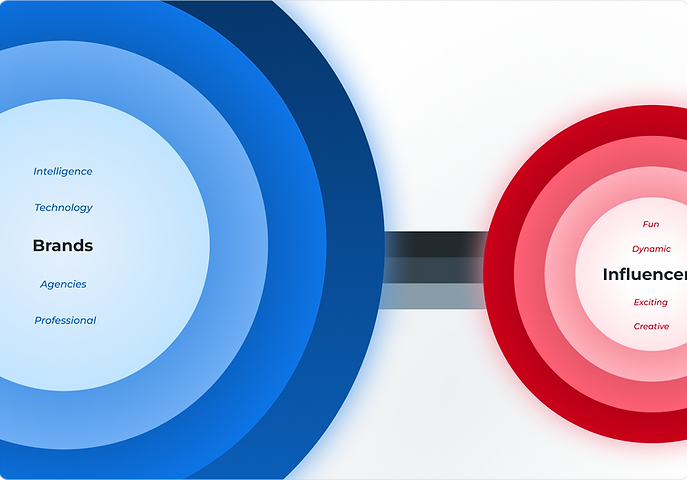
I designed 2 visual approaches, one for B2B users (more minimalistic) and another for creatives/creators (more expressive).
Deliver brand guidelines
At the end of this rebranding project, I delivered a brand book, a brand guideline on Zeroheight & Canva, digital assets, merch, and other physical assets.



Website
I worked closely with the Director of Marketing to create a new website using our new branding with a focus on promoting our client service experience at the time.

Shifting gears to product
After years of rapid growth, Creator’s platform had become fragmented and inconsistent. The company wanted to evolve toward AI-driven workflows, but the foundation was not ready for that level of intelligence.
My process

Competitive research & heuristic evaluation
Influencer marketing was still a relatively new landscape, and a lot of our competition’s platforms were solving the same problems in very different ways. However, users tend to report that using these platforms effectively was overwhelming (G2 reviews).
I then went back to our platform, looped in the development team, and conducted a heuristic evaluation together.
The development team also flagged technical constraints around how the platform was built, which was helpful for prioritization and future planning.

20+ user testing & interview sessions, churn feedback reviewed
Within 2 weeks, I ran user testing & interview sessions with our core users, like small- to medium-sized brands, agencies, our internal client service team, and some marketing experts.
They all had different levels of tech & influencer marketing knowledge, and came from different industries.
Based on their feedback, I mapped out a Current Journey Map and added in the feedback notes along each step of the journey. I then could identify common pain points and frustrations for these users.

Insights

Difficulties in influencer recruitment
Brands couldn’t efficiently discover or recruit high-quality influencers with just the platform without support & knowledge. It is a time-consuming process ranging from several days to weeks to find the right influencers.

Fragmented experience
Main workflows were fragmented and overwhelming from both a front-end and back-end perspective.
This created significant challenges for implementing automated AI workflows.

Accessibility and consistency issues
Lacking a unified design system, the interface was inconsistent and full of accessibility issues.
The engineers had been building every component from scratch, hindering the efficiency of development.
Focus on Brands’ Self-serve experience
Startups / SMBs, Enterprises & Agencies are not all equal.
My focus was mainly on improving the small and medium brands’ experience.
I partnered with the Client Service team (who onboarded hundreds of brands) to audit friction points across the journey. Furthermore, I also conducted user interviews with around 10 different brands - from startups, mid-level companies, big brands like Best Buy, Fenders, and our agency partner.
The team wanted to challenge the assumption that these different stakeholders should have the same workflow.
Smaller brands tend to deal with limited influencer marketing expertise, difficulty in adoption, and overall limitations in budget and time. They needed more guidance and likely preferred a more automated experience.
Meanwhile, enterprises and agencies tend to prefer a more robust and consolidated experience that addresses many different use cases. They prioritized flexibility, scalability, and security.
With that said, they all share the same frustration: looking for value-aligned, high-quality influencers to collaborate with.

Persona
I led co-creative workshops with internal teams and important stakeholders to build out user journey maps for each user, identifying pain points, user needs, and areas for improvement. Eventually, we decided to prioritize small- and medium-brand users.

AI-powered workflows & features
The goal was to gradually increase automation as we validated accuracy and usefulness, while still giving users enough control and visibility into how the AI was making decisions. That transparency was key to building trust and driving adoption.
We approached each AI-assisted flow in phases:
-
Phase 1: high user control, low automation
-
Phase 2: balanced control and automation
-
Phase 3: low user control, high automation
AI-powered workflow
Creator discovery & matching
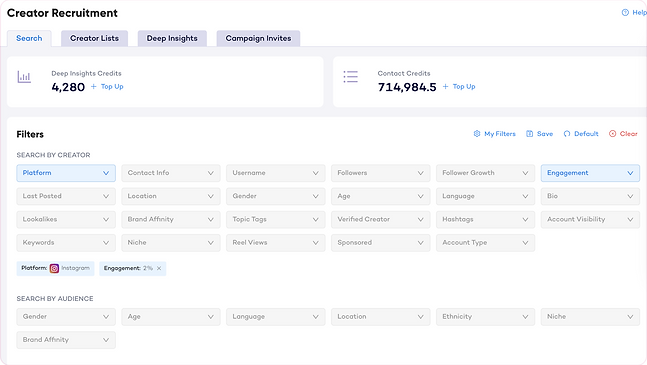
The problem
At the time, the influencer discovery feature aided brands in utilizing a set of filters and keyword searches to surface the right influencers in our database. However, this process was time-consuming and tedious, demanding that brands check several hundred profiles to assess fit for just one campaign.
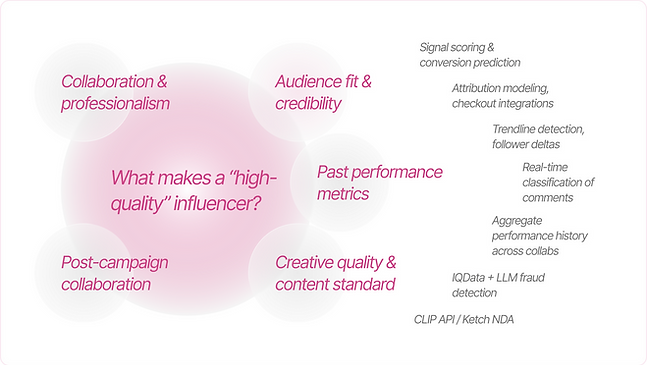
How might we assess if an influencer is “high-quality” for specific brands/product lines, using AI?
With our research insights, we were able to align on a set of data points to identify a good influencer: high audience fit & credibility, past performance metrics, creative quality & content standards, collaboration & professionalism, and post-campaign collab potentials.
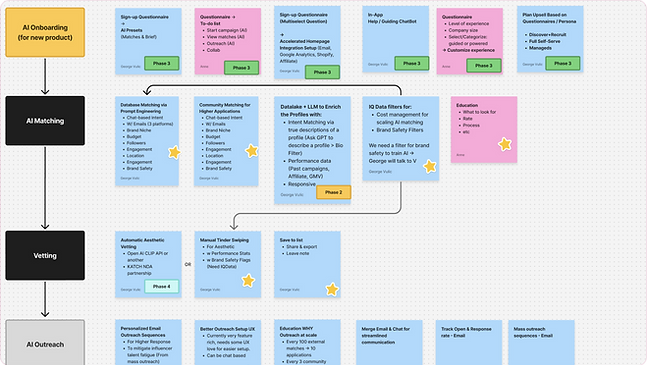
Plan the different phases of AI integration
For each criterion, my product lead identified measurable metrics and opportunities/gaps to implement AI-tech.
We mapped out the experience from Onboarding to Influencer Matching & Vetting and brainstormed the ideal experience and solutions to transform the current experience. We then discussed with the engineering lead to prioritize and assess feasibility, and then categorized these into different phases of development.

Launching the first phase
The team was able to release the beta of this feature, allowing existing brands to utilize and test with their specific industry segments. We were fine-tuning the AI further to work with more niche industries, return more relevant results by logging brands’ real usage data, hosting testing sessions with different brands from different industry segments, and improving the system iteratively for several months.

Launching the second phase
Moving to the next phase, we surfaced the AI much more for small and medium brands that needed guidance in finding influencers, while the filters were still accessible for them to play around with. Our agency clients, however, preferred using the existing filters, which we kept as the main component of the discovery interface for them.
AI-powered workflow
Self-serve experience

The problem
We brainstormed ways to make the entire experience of creating, launching, and managing campaigns even more streamlined and efficient with AI. The product lead and I were mapping out potential ideal AI-powered flows while conversing with the engineering lead for feasibility concerns.
While there was definitely an eagerness to automate as much of the process as possible, authenticity and human connections still matter a great deal in influencer marketing. Working closely with our client service team, we identified where AI could potentially add value and not take away from the experience.

Approach
After being in several strategy sessions with the leadership team, reviewing the user flows, assessing our competitive advantage, we narrowed down the scope significantly and shape an MVP - a lite self-serve experience that could be sold on the shelf.
This MVP covers onboarding, influencer searching & outreaching, and some basic functionalities of campaign builder and management.
Self-serve Conceptual Mockup
Several iterations later, we arrived on a conceptual mockup that translated what we had in mind for the MVP of the AI-powered experience.

Upsale flow
Checkout & Upsell
I designed a checkout flow to upsell our premium plans and multiple other features for the dashboard. For each project, I delivered handoff documents and files with clear notation, explanation, prototypes, and specs in Figma and Notion. I hosted meetings with the development team regularly to align and co-create together.

UI styleguide
I spent a week putting together a UI styleguide and a component library while balancing other projects. This initiative has greatly improved the platform’s visual consistency and accessibility and sped up the development process significantly.

Investor deck
I also designed an investor slide deck for our new AI initiative that contributed to Creator.co secured over $2M in funding.

Recap & learning
It was a challenging but rewarding experience because I learned so much at Creator.co. I really stretched myself as the sole designer, leading brand and product design while contributing to marketing and strategy work, helped craft an experience in a fairly new industry - influencer marketing, and drove business outcomes.
This is also the first time I got to practice and learn the process of building and designing AI-powered features in a real-world context, thanks to my product and engineering leads.