About
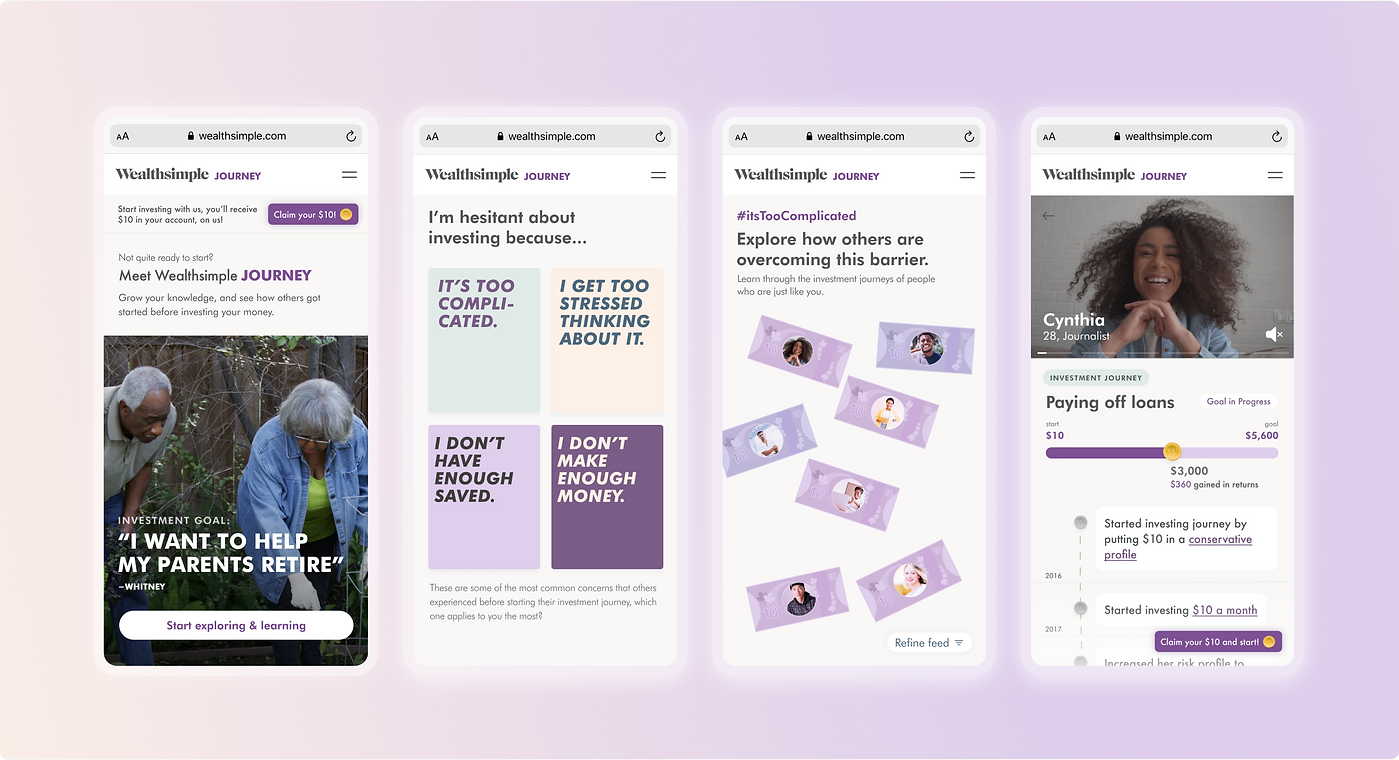
Wealthsimple Journey is a financial literacy tool created for individuals who live in Canada that suffer emotional, psychological & cultural barriers stopping them from investing.
Overview
This is an experience design project for a senior design class.
I conducted user research, user discovery/interview, acted as the strategist/decision-maker, scoped the project, built prototypes, wrote & conducted user testing.
Our process
We ran a 5-day sprint: define, sketch, scope & prototype, test, and iterate.

1 • Research & Discovery
The barriers to investing
Wealthsimple:
Challenge with the real entry point
Wealthsimple Invest is a Canadian online investment management service, whose mission is to make money management easy & lower barriers to financial literacy.
Even though they do provide resources for educational purposes, they do not address the barriers that users have to overcome to even start familiarizing themselves with financial literacy.

Research surveys + Qualitative interviews


Secondary research:
Understand why these barriers exist
We studied a diverse group of people’s investing habit, and for the ones who do not invest, we identified a list of barriers they were experiencing.
One of the highlights is that people are heavily influenced by their upbringing, and tend to rely mainly on their family to get financial information & advice, which is our main assumption going into the user research sessions.s

To gather more insights & validate the assumptions we made during the secondary research, we conducted 3 qualitative interviews & sent out a survey form to a diverse group of people during the first day of our sprint. I wrote the interview guide, refined the research goals, and facilitated a couple of sessions.
Based on the survey responses, the number one reason people are not investing is a lack of knowledge. Other reasons have to do with a person’s financial situation (having debt to pay) and mainly psychological barriers. Lack of knowledge is also reflected as a reason in the qualitative interviews, along with the influence of upbringing (commonly seen in the second-generation immigrant group).


2 • Strategy & Ideation
Reframe the mindset
Based on findings from the secondary & primary research, we refined our problem statement, defined the team’s goals and tackled possible downfalls:
“We want to build a financial literacy tool targeted at individuals in Canada with emotional, psychological or cultural barriers that are stopping them from investing, in order to allow them to reframe their mindset towards money by helping them realize the benefits of investing and dispelling myths that might be holding them back.”
We then altered the initial framing statement to be more impactful and fit in more nicely with Wealthsimple’s business model. The primary goal was no longer to “make the entry point approachable”, but to “convert awareness into actions”.
“How might we convert awareness into action for individuals who are predisposed to an anti-investment mindset?”

Ideation & scoping
With the HMW statements, we brainstormed ideas for solutions, wrote them on post-it notes, and grouped them on the board.
These ideas were then synthesized and put on another whiteboard for us to keep track of our decision-making. We did several sketching exercises to generate ideas and vote on them.

As the team’s strategist, I was tasked with prioritizing the items to move forward with. It was useful to see a pattern of how team members utilized visualization to promote understanding & foster a fun, engaging, approachable learning environment.
Remap & Wireframe
3 core ideas for our intervention
• Providing incentives for actions
• Dispel common myths about investing
• Financial literacy packaged as storytelling
The next step was to integrate the ideas we had into an experience map. The challenge here was to pick and choose the most impactful ideas (being able to convert awareness to actions). We got the help of a fintech expert to prioritize with us.
3 entry points for our intervention
• Wealthsimple Invest website: on the navigation tab
• Social media campaign: an Instagram post
• Invite link: user can invite other people to join the platform

3 • Prototype & Test
Divide & conquer
Round 1: Quick & dirty testing with the low-fidelity for concept validation
Round 2: Usability testing with the mid-fidelity
Measure success: with positive comments and feedback, and system usability scale (SUS) results
How/Who:
Think-aloud & Survey with 11 testers - 4 males, 7 females (20 - 26 years old, varied backgrounds & races, financially ready to invest but are not investing)
Why:
Examine if the design can inspire people to start thinking of themselves as investors, and ease their anxiety about investing
User testing 1
“I am inspired by people I can relate to, not financial experts.”

Recap:
We created a couple of screens that outlined all the key ideas for concept validation. We showed this to 3 people and got a lot of useful insights to move forward.
Critical insights:
Goal: for all testers, seeing other people that they can relate to who have achieved their financial goal is inspiring
UI: testers think this is a part of Wealthsimple Invest because of the color yellow
Content: testers needed more context about the story, and more clarification on where the incentive comes from, and what they are supposed to do next
Next step to consider:
How might we show users the investing stories of people that they relate to and care about?
User testing 2
“Are people willing to share their investing journey?”

Recap:
A mid-fidelity prototype was created to test with 6 people.
Critical insights:
Goal: the narrative is strong & convincing to the testers, they liked how they could filter stories
UI: The testers thought the implementation of the brand was good and polished.
Security concern: Some testers were concerned about their safety on the platform if they were sharing their own investing journey, while some said they were willing to share if it could inspire other people like them.
Next step to consider:
How might we create trust on the platform?
How might we leverage the existing resource on Wealthsimple to create an educational experience for our users?

4 • Refinement & Reflection
Promote trust with design
Art direction & Brand guideline
We studied Weathsimple brand pillars and had a teammate crafting the branding identity of the platform.
With that guideline, as well as considering user insights, I was working intensively on the high-fidelity design of several screens.

Feature
An engaging hook
For the landing page, I utilized candid stock gifs to envision people’s goals in the context of taking care of loved ones & themselves. I managed to create visual & emotional interests, while also targeting different user groups on the page without overwhelming the viewer with a lot of content (which was a feedback we got).

Feature
Stories to inspire
According to our user testing’s insights, most people are inspired by someone they can relate to (based on different criteria like goals, background, career stage, identity, etc). We wanted to create a way to help them find stories they like.
I improved the questionnaire visually, broke it into digestible chunks to make the searching process engaging and easy for users.

Feature
Learn & explore
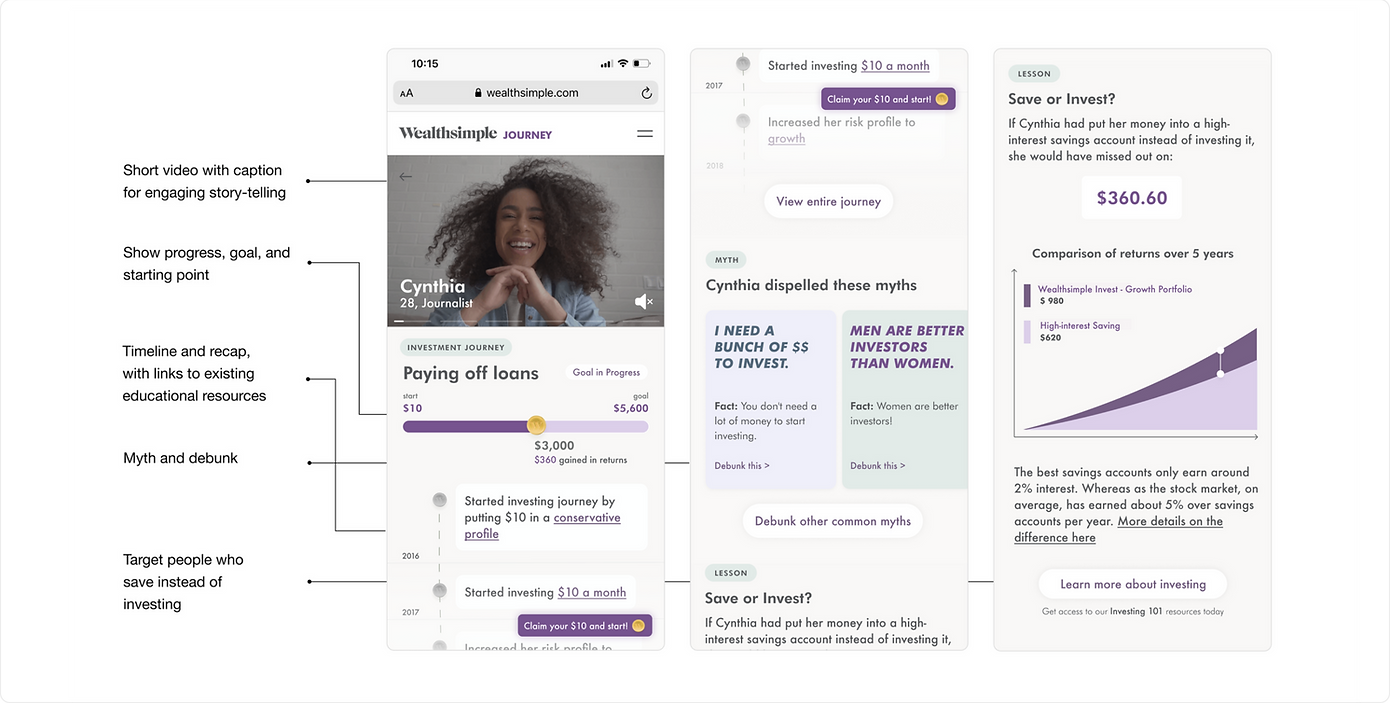
One of the challenges for this page was organizing the large amount of information into 3 big sections. Our testers expressed wanting to be able to dive deep into each of these sections to learn more. We had to figure out a way to show them all this information without making it overwhelming.
I was able to prioritize high-level information with the team, and polished the UI for this page so that it is scannable, but also allows for further exploring opportunities.

Recap & learning
This experience taught me a lot about running the design sprint process and how to quickly validate design decisions, which was vital to the success of this project.
Wealthsimple Journey ended up being one of the best projects in our class. We also learnt to work well with each other, and formed some of the best friendships I could ever have. Thank you, Zoe, Erin, Kaitlyn, and Anna, who are amazing designers and such good friends.